Why no free tool checks the web
Comparing your text against everything published would require a crawl of everything published. That is an enormous, continuously updated index, and the handful of organisations that maintain one either sell access or use it for their own search product.
So a free plagiarism checker cannot do what its name promises. What free tools actually do varies: some search a few phrases through a public search engine and report the hits, some compare against a small archive, and some report a confident percentage derived from nothing much at all.
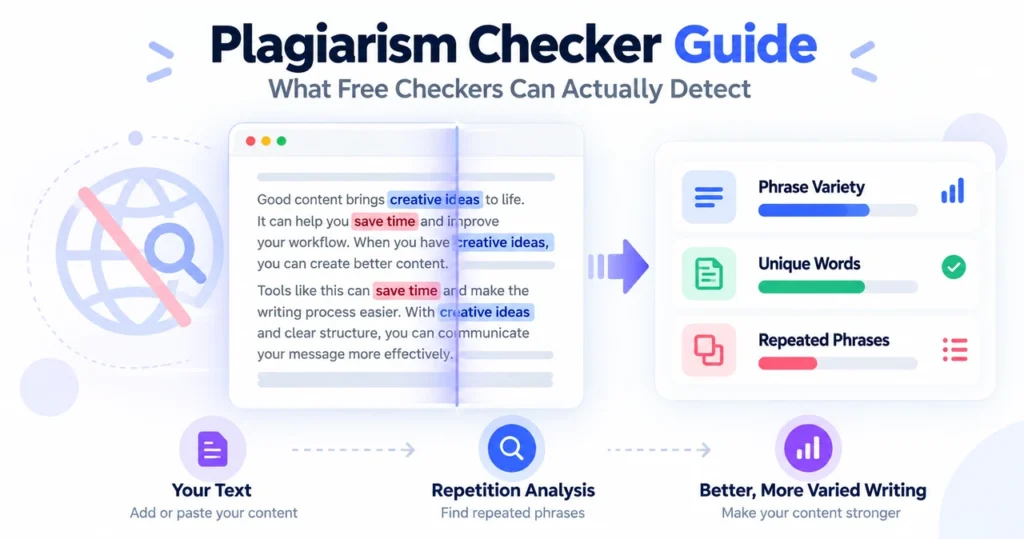
The مواد کی انفرادیت کا اینالائزر does not pretend. It has no index and does not search anything. It measures repetition inside the text you paste — how often you reuse the same phrases and the same vocabulary — which is a different and genuinely useful measurement.
What the score is measuring
Your text is split into overlapping three-word phrases and the distinct ones are counted. That figure is weighted against the ratio of unique words to total words, roughly seventy per cent from the phrases and thirty from the vocabulary.
A high score means you are not repeating yourself. It says nothing whatever about whether anyone else has written the same thing, and reading it as an originality score against the internet is the one misinterpretation to avoid.
Three-word phrases are the right unit because that is where unconscious repetition lives. Nobody notices reusing in order to eleven times; the phrase count does.
Why internal repetition is worth catching
- It is the clearest tell of generated text. Models circle a small set of constructions. A low variety score on a draft you did not write yourself is a strong signal about which sections need rewriting.
- It flags padding. Text that says the same thing three ways is text that could be a third shorter without losing anything.
- It shows up in long documents. A phrase you like reappears every few pages. Readers of a report notice; you, writing it over three weeks, do not.
- It correlates with dull prose. Low lexical variety is what makes writing feel flat even when every sentence is correct.
Reading the score sensibly
Do not chase a number. Variety is partly a function of subject: technical writing legitimately repeats terms because the terms are precise and substituting synonyms would be wrong. A page about canonical tags should say canonical often.
Length matters too. A short passage has few phrases and the ratio swings wildly. Anything under a couple of hundred words will not give a stable reading.
So use it comparatively. Run two of your own pieces, or a section you are happy with against one that feels flat. The difference between them tells you far more than either figure alone.
If you actually need originality checking
- Search exact phrases yourself. Take three distinctive sentences, put each in quotation marks in a search engine, and look. It is manual and it genuinely works for spot checks.
- Use your institution’s tool. Universities license real comparison services, and their result is the one that counts in an academic dispute.
- Pay for a commercial checker if publishing volume makes it worth it. The cost buys the index, which is the entire product.
- Keep your drafts. Version history and revision timestamps are stronger evidence of your own authorship than any score, and they are free.
Rewriting is not a solution to plagiarism
Worth stating plainly. Running someone else’s text through a rewriter until the phrases differ does not make it yours — it makes it a paraphrase, which still requires attribution and still counts as misconduct if presented as original.
Ideas need citing as much as words do. If a source shaped what you wrote, name it. That is the actual answer to the question people are asking when they reach for a plagiarism checker on their own writing.
Improving variety without damaging clarity
Cut before you substitute. Most repetition disappears when the padding around it goes, and that improves the writing twice over.
Vary structure rather than vocabulary. Repeated sentence shapes are more noticeable than repeated words, and reaching for synonyms to raise a score is how you end up with a thesaurus smell and imprecise terminology.
Then read it aloud. Your ear finds the phrase you have used four times faster than any counter, and it also tells you which repetitions were deliberate and working.
Everything runs in your browser. Nothing you paste is transmitted or stored, which is what makes it reasonable to check an unpublished manuscript here.